eScada features

Features

All eScada features at a glance.
Click on a feature to read its details, or get the full document: eScada.Features

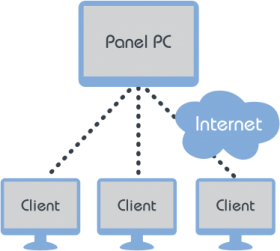
Native Client-server Clients receive the configuration from the server and render pages natively: after that, only tag values travel, keeping the interface fast even over VPN.

TCP/IP sockets and Ethernet support guarantee a high level of connectivity between the eScada server component and several other eScada client components.

It is not necessary to distribute anything to the clients: they receive the whole configuration from the server, so every change made to the project reaches all the connected clients immediately, with no installation and no alignment procedures.

From everywhere in your company, or from a remote site using VPN, you can operate with your equipment as you were in front of it.

Native rendering, native performance

The eScada client draws the HMI pages natively, using the graphical interface of the platform it runs on. Pages are rendered as real native controls: the result is a fast and fluid interface, with low latency and a small memory footprint, that performs well even on compact hardware such as panel PCs.

Since the rendering engine is the eScada client itself, pages look and behave exactly the same on every supported platform. The behaviour of the interface does not depend on third party software installed on the machine, nor on its updates: what you design is what every operator gets.

Efficient by design

The configuration is transferred once, when the client connects. From that moment on, the only data travelling between server and clients are tag values: the server evaluates, for each tag, which items have changed and sends only those, while the client sends a value only when the operator modifies a tag through the interface.

No polling, no page reloads, no graphical resources on the wire: the traffic is reduced to the essential, in both directions. This keeps the interface responsive on the local network as well as through a VPN connection to a remote site, even when the bandwidth is limited.

Connections are dedicated eScada sessions inside your company network or through VPN: nothing has to be published towards the outside to let operators and maintenance staff reach the equipment.

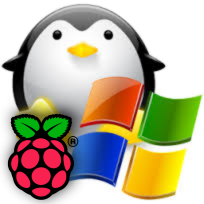
Native Cross-platform Windows and Linux, x64 and ARM, Raspberry Pi and RevPi included. One folder, any machine: no installation procedure, no compilation.

eScada is natively cross-platform: the same HMI solution runs on Microsoft Windows and Linux, on both x64 and ARM processors, without recompilation and without any installation procedure. You design your project once, then deploy it on the operating system and hardware that best fit your needs: from a server or industrial panel PC down to a Raspberry Pi.

Microsoft x64, ARM

  • server from version 2008 R2 to version 2022
  • desktop from Windows 7 to Windows 11
  • embedded from Windows 7 to Windows 11 IoT
  • Windows on ARM

Linux x64, ARM

  • all modern Linux DEBIAN based distributions

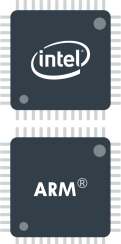
Even the hardware architecture is your choice: the application binaries we can provide are available for x64 or ARM processors. Raspberry Pi with their OS versions are fully supported, even Windows on ARM OS is supported.

Compiled for your operating system, not adapted to it

eScada executables are compiled natively for each supported operating system and processor architecture. There is no virtual machine, no interpreter and no compatibility layer between the application and the platform: the binaries run directly on the hardware they were built for.

The benefits are concrete: fast start-up, low CPU and memory usage, and stable, predictable performance over time. Native code makes the most of the resources available, so the same solution performs well across the whole hardware range: what an industrial server does with ease, a compact ARM board can still do reliably.

Switching hardware or operating system never means rebuilding anything: the project is the same, you simply pick the executable folder that matches the target platform.

It doesn't require any kind of installation procedure nor compilation for anyone of them. Just copy a folder and start.

Zero-install deploy No installation: the whole solution lives in one folder. Copy it to any other hardware, or a removable support, and be running in minutes.

The entire HMI solution doesn't require any installation: everything it needs lives in a single folder. Deploying eScada, on the first machine or on the next one, is as simple as copying that folder to the internal disk, to a network share or, if you prefer, to a removable support.

This makes moving or duplicating a solution a matter of minutes: copy the folder to another laptop, desktop PC, industrial panel or server, start eScada, and you can continue to operate with your equipments. No installers, no dependencies to satisfy on the target machine.

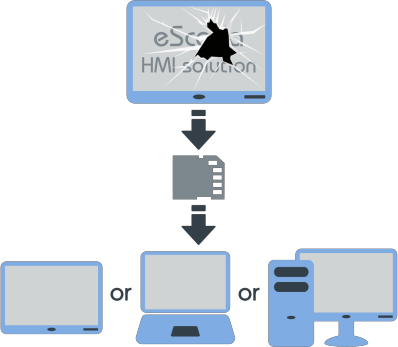
The same simplicity turns disaster recovery into a trivial operation. If the hardware breaks, either move the removable media to a spare machine, or restore a copy of the solution folder on any other computer in your company: within minutes the supervision is back, with the same project, the same data and the same behaviour.

When an HMI stops, production usually stops with it, and machines and plants are left without supervision. Reducing the recovery to copying a folder and starting an executable means measuring downtime in minutes instead of days spent waiting for a technician or a replacement unit: a concrete benefit for productivity, and for the safety of machines and plants.

Even the OS version you are running is not of importance, as you can run your HMI solution using other types of hardware and OS.

Easy backup and restore Back up the entire HMI solution and your recipes data with simple HMI commands, and restore them whenever you need.

The whole solution can always be saved by copying its folder, but eScada goes further: backup and restore are also available as HMI commands, directly from the pages of your interface.

Backups are based on the ZipFolder derived object: the developer declares which folders have to be archived, and a button on a page produces a ZIP archive of them, ready to be restored whenever you need it. This means backups can be performed by the people who actually operate the machine, without file system access and without IT skills.

Recipes and production parameters are typically the part of a solution that changes every day. With HMI commands you can build your own archive of recipes, keep it up to date during normal operation and restore a recipe whenever a production batch requires it: your production know-how is always in a safe place.

Like any other client-side action, backup and restore commands are protected by user permissions: groups and users let you decide exactly who is allowed to use them.

Data encryption Files, communication channels and project data protected with keys derived from project passphrases: a vital security layer for data in transit and at rest.

Data encryption protects your projects and your production data from unauthorised access, both in transit and at rest. eScada implements it through multiple layers of protection:

  • All communication channels between the server and clients are encrypted with keys derived from passphrases defined in the project, ensuring secure data transmission across the network.
  • All runtime files generated for alarm management, trends, and recipes can be optionally encrypted with individual keys derived from passphrases defined in the project, providing granular control over sensitive operational data.
  • Project files themselves are encrypted to create a secure vault for all configuration data, design specifications, and system parameters, ensuring that only authorised individuals can access the core project contents.

All keys are derived from passphrases defined in the project: you decide what to protect, and with which secrets.

Action traceability Parameter modifications and user access operations can be logged to your own database or to plain text files, building complete events and audit trails.

Who did what, and when: activities such as parameter modifications and user access operations can be tracked by the HMI solution, generating a log entry for every relevant event.

Tracking is provided by dedicated system objects: user logins and changes to the values of writable items can be recorded either to plain text files or to a database of your choice, using the same database connectors described in Database integration ($SYS.Utility.UsersLoginTxt, $SYS.Utility.UsersLoginSql, $SYS.Utility.UpdatingValuesTxt, $SYS.Utility.UpdatingValuesSql), so the traceability data ends up exactly where your quality system expects it.

For the company this answers a growing need: demonstrating how the plant has been operated. Traceability data supports quality procedures, helps to reconstruct the sequence of events after an anomaly, and gives production and maintenance managers an objective picture of what happened, when, and by whom.

Users can log in to the HMI system in the classic way, with user name and password, or by means of RFID badges. The access mode is configurable and can even be hybrid, combining both methods: a badge makes the access faster and personal, encouraging operators to work each with their own identity, which is the foundation of meaningful traceability.

Industrial server protocols Several instances of OPC-UA, Modbus TCP server, HTTP and Weihenstephan standards fully supported, ready for Industry 4.0 integration.

Besides talking to PLCs and field devices, the eScada server can itself act as a data source for the rest of the factory: several instances of common server protocols can be configured and run at the same time.

Currently Modbus Server TCP, HTTP, OPC-UA and the Weihenstephan Standards for Production Data Acquisition are fully supported.

Through these open standards, the data of your machines becomes available to company systems without middleware and without custom developments: MES and ERP systems, data collection platforms and analysis tools can read production data directly from the HMI solution, each through the protocol it prefers.

The Weihenstephan support deserves a special mention: the implemented physical interface is aligned to Version 8 for bottling and packaging plants and machines of the food industry, making the solution ready for the standardised data acquisition required in that sector.

From everywhere in your company, or from a remote site, these open standards make the HMI solution ready for Industry 4.0 integration.

20+ PLC drivers Allen Bradley, Siemens, Omron, Mitsubishi, GE Fanuc, Modbus, CAN Bus and more. New communication drivers are implemented on request.

Native communication drivers connect the eScada server directly to PLCs and field devices: no gateways, no middleware, no additional software to buy and maintain.

A server can run several communication channels at the same time, each one associated with a protocol; under each channel, several devices speaking that protocol can be configured. Every device exposes its own array oriented tags, and each element of an array can be configured individually with engineering units, notes, scaling and other attributes: vectors for efficiency, fine grained configuration where it matters.

Other kinds of communication drivers are works in progress and are not listed, but in the event your device does not support any of the protocols listed below, do not hesitate to ask for its implementation. We are very pleased to implement communication drivers on request.

  • Allen Bradley EIP - Ethernet
  • Allen Bradley PCCC - Ethernet
  • Allen Bradley DF1 - Serial
  • Applicom (Windows x86 OSs only)
  • CAN Bus USBTin (fischl.de/usbtin)
  • CAN Bus SocketCAN (Classic CAN and CAN-FD)
  • General Electric SRTP - Ethernet
  • Kernel PLCs TCP - Ethernet
  • Kernel PLCs - Serial
  • Kunbus (Revolution Pi, revolution.kunbus.com) - Direct I/O
  • LTI Servo One - Ethernet
  • Mitsubishi FX (PRG) - Serial
  • Mitsubishi Computer Link - Serial
  • Mitsubishi SLMP1E - Ethernet
  • Mitsubishi SLMP3E - Ethernet
  • Modbus TCP - Ethernet
  • Modbus RTU - Serial
  • OMRON CMODE - Serial
  • OMRON FINS Serial - Serial
  • OMRON FINS TCP - Ethernet
  • OMRON EIP (CIP) - Ethernet
  • OPCUA Client - Ethernet - TCP transport
  • Saia Burgess S-BUS - Serial
  • Siemens S7 protocol - Ethernet (even for MPI to Ethernet adapters)

The full documentation for every driver is available in the Documents section.

Database integration Read and write data on Microsoft SQL Server, MySQL, Oracle and the other major database engines using OleDB technology, on both Windows and Linux.

eScada can read and write data on the major database engines: SQLite, MySQL and Firebird connectors are included, Microsoft SQL Server is supported, and on Windows the OleDB connector opens the door to Oracle and many other engines available on the market.

At the heart of the integration is the SqlCommand object: any SQL command, parametrised with live tag values, can be executed on event or on demand, synchronously or asynchronously, and the returned dataset is written back into project tags, ready to be displayed on the pages or processed by the application logic.

This means the HMI solution can do a bit of everything with your data: record production results and quality data batch by batch, read work orders prepared by company systems, feed reports and analysis tools, or exchange information with other applications through a shared database. Execution times, error counters and error descriptions are exposed for every command, making the integration robust enough for continuous production use.

Microsoft SQL Server is supported on both operating systems, Linux and MS Windows.

Email & HTTP Send emails with SSL/TLS and STARTTLS security, and perform HTTP and HTTPS requests directly from your HMI solution.

Sending emails with SSL/TLS, STARTTLS security is fully supported: following field generated events, the HMI solution can notify operators and supervisors by email.

An alarm, a threshold crossed, the end of a production batch: whatever the event, the right people are informed immediately, even when nobody is standing in front of the HMI. The plant reports by itself, maintenance can react before a small anomaly becomes a stop, and supervisors keep an eye on production during nights and weekends without being on site.

HTTP and HTTPS requests are implemented as well, allowing the HMI solution to exchange data with web services and remote systems.

This turns the HMI solution into an active node of your company systems: production data can be delivered to corporate applications and remote platforms, and information available on the network can be brought back to the operator pages.

Lua programming language Lua is embedded in eScada to offer an efficient way to operate with data, extending derived tags and integrating external C, C++ and C# libraries.

Lua is a powerful, lightweight scripting language embedded in eScada. Within the eScada programming hierarchy it represents the highest level context, sitting on top of Expressions, Derived Objects and Macros: while those efficiently handle data pre-elaboration, functional blocks and sequential commands, Lua provides a full modern scripting environment for complicated logic, advanced algorithms and sophisticated system behaviours.

Lua modules can be used in two ways: as "LuaModule" derived objects, ideal for small pieces of code executed by triggers, or as external .lua files stored in the project's own "lua" folder. A dedicated Lua context in the development suite offers the tools to manage large modules comfortably, and modules can optionally receive parameters, so the same script can behave differently across devices and configurations.

The entire Lua code can interact with eScada objects through dedicated contexts:

  • esProject: project information and system commands: read and write whole groups, save and load tag values, take snapshots of the running project
  • esSystem: file system utilities: user and temporary paths, file and folder checks, ZIP archive creation
  • esUtility: general purpose helpers: bitwise operations, Base64 encoding, UUID generation, CRC-16 and CRC-32 checksums
  • esEncryption: SHA-2 hashing, key derivation from passphrases and AES-256 encryption and decryption
  • esString: string manipulation with full UTF-8 support, plus runtime translation using the project languages
  • esTags: full access to project tags: read and write values, batch updates, scaling limits, metadata, polling and offline status
  • esNotification: activate, acknowledge and reset notifications, and update their messages dynamically

An advanced use of Lua permits to integrate other external libraries written using C, C++ and C# languages.

The complete guide, with syntax, recommendations and examples for every function, is available in the eScada.Development.Lua document.

SVG images Scalable Vector Graphics as image resources: shapes described mathematically, scaling infinitely without losing quality at any resolution.

SVG (Scalable Vector Graphics) is an XML-based image format for defining two-dimensional vector graphics.

Unlike raster images (e.g. JPEG, PNG), which are composed of pixels, SVG uses mathematical formulas to describe shapes, paths, text, and colour, allowing images to scale infinitely without losing quality.

SVG images can be imported in the project resources and used everywhere an image resource is expected, keeping your pages sharp on any screen and resolution.

For a machine builder this means designing the graphics once and deploying them everywhere: the same synoptics stay sharp on a compact operator panel, on a full HD desktop client and on a large supervision screen. Company logos and technical drawings keep their quality on every installation, and a single set of resources serves the whole range of your machines.

Animations Animated images in WebP and GIF format can be imported as project resources and played on your HMI pages, bringing pictures to life.

Animated images of type WebP and GIF can be imported among the project resources, just like any other image.

A dedicated object is available in pictures to perform the animation, so animated resources can be placed and controlled directly on the HMI pages: useful to draw the operator's attention, to illustrate the movement of a machine part, or simply to make the interface more lively.

GIF animations can also be used inside HTML code destined to the "HTML Window" widget, combining animated content with formatted text and data.

Used with care, animations make the state of the machine readable at a glance: a moving part that actually moves on the page, a flow that visibly runs through a pipe, a blinking element that draws the eye exactly where attention is needed. Operators understand what the plant is doing before reading a single value, and react faster when something changes.

Languages & audio Localized user interface for multicultural plants, plus playback of WAV and MP3 audio resources differentiated by language, on server or client side.

Nowadays in our companies there are a mix of cultures from all around the world. Several languages are spoken and it is important to offer to the operators the opportunity to read the HMI interface using their own language.

Every string of the interface can be translated, and each client selects its own language: the same solution serves a multicultural crew on one site, or machines delivered to customers all over the world. Fewer misunderstandings mean fewer operating errors, faster training of new operators and a safer plant. Translations are managed with a dedicated tool, eScada.Tools.Translator: if the machine builder provides the tool and the credentials, final customers can complete or refine them autonomously, without touching the project.

Following field-generated events, it is possible to trigger the playback of audio files in WAV or MP3 format. As with image resources, audio files can be differentiated by language; this allows each client to play audio messages in the same language as the user interface.

Audio messages complete the picture: spoken phrases triggered by machine and plant events reach the operator even when he is not looking at the screen, in the language he understands best.

Audio files can be played either on the server side or on the client side. When played on the client side, it is also possible to specify the address of the client(s) where a specific audio file should be played.

HTML browser New A true web browser integrated in your HMI pages, capable of running modern HTML 5.0 websites: corporate portals, web applications and more.

The HMI pages you design can host a true integrated web browser, capable of rendering modern HTML 5.0 websites.

This opens the HMI solution to everything the web can offer: from within your pages, operators can reach corporate portals, intranet applications, web-based dashboards, machine and equipment documentation, and any site available on the internet or on the company local network, all without leaving the HMI environment and without switching to an external application. Manuals, quality procedures and troubleshooting guides become available at the point of use, exactly when the operator needs them: less time searching for information, less downtime.

The browser lives inside the picture like any other object, so web content can be combined with process data, alarms and commands on the same page, keeping the operator in a single, coherent working environment.

For simple formatted text parametrised with server tags (such as reports, help files and structured data), the lightweight "HTML Window" object is also available, designed for fast rendering of static content.

VNC client New An integrated VNC client to reach and operate remote systems directly from your HMI pages, without installing external applications.

An integrated VNC client allows to reach and operate remote systems directly from the HMI pages.

The remote desktop is displayed inside the picture, so operators can interact with other machines and devices of the plant without leaving the HMI solution and without installing external applications.

In a real plant the HMI is rarely alone: vision systems, robot controllers, dedicated PCs and third party equipment live alongside it, each with its own interface. With the integrated VNC client all of them become reachable from the supervision pages, and several remote systems can be displayed at the same time if needed: fewer walks across the plant, faster interventions, and a single station from which the whole line can be observed and operated. Through a properly configured VPN, with the client reachable as its endpoint, the same pages let you assist a remote site as if you were standing in front of it.

RTSP streaming New Show live camera streams inside your pages through the RTSP protocol, keeping an eye on the plant right next to your process data.

Live camera streams can be displayed inside the HMI pages through the RTSP protocol.

This allows operators to keep an eye on the plant, machines and critical areas right next to the process data, without dedicated monitors or external viewers.

Seeing is deciding: when an alarm fires, a live image of the area tells immediately whether it is a false trigger or a real problem, before sending anyone on site. Several streams can be displayed at the same time on the same pages, critical or dangerous areas can be checked visually before restarting a machine, and through a properly configured VPN the same streams support remote assistance and unattended installations.

Cameras and ONVIF-compliant devices can also deliver their events to the HMI solution: see ONVIF integration.

ONVIF integration New A profile-agnostic ONVIF event client: subscribe to cameras and devices, receive their events and react to them from the HMI solution.

eScada integrates a profile-agnostic ONVIF event subscription client, which manages the complete lifecycle of a WS-Eventing PullPoint subscription with ONVIF-compliant devices.

Each received event notification is delivered as raw XML and pushed into a queue, where it can be processed asynchronously by a dedicated Lua module: all semantic interpretation is left entirely to the application. This design ensures compatibility with any current or future ONVIF profile (S, G, A, T, M, C, D), as well as with vendor-specific topic extensions.

Common types of ONVIF-compliant devices include: IP cameras, PTZ cameras, thermal cameras, access control devices, video analytics devices, audio devices, environmental sensors and multi-sensor cameras.

Topic strings, data item names, and the presence of optional fields such as temperature values or object identifiers are not mandated to be identical across manufacturers: devices must conform to the topic namespace structure defined in the ONVIF Event Service Specification, but may extend it with vendor-specific sub-topics. The raw XML preserved in each notification provides access to the complete original payload, allowing the application to handle both standard and vendor-specific fields.

The structure and content of ONVIF notifications are fully defined by the ONVIF specifications, the authoritative references for topic hierarchies, data item names, property operations and the WS-Eventing protocol. All specifications are available at www.onvif.org.

Licences management New Self-service licence management: your run-time licences ready to activate, already tied to your orders and jobs, with your notes and end customers.

eScada customers get access to a private, self-service licence area where you can activate and manage all your run-time licences in one place: no emails, no waiting. Sign in with the credentials provided by eScada and you are ready to go.

What you can do

  • Activate licences yourself. Choose an available licence, check the purchased options, paste the registration key shown by the software and instantly obtain your activation key. Record the product version and, if you wish, your own job and order references.
  • Keep everything organised. Every activated licence is listed and fully searchable, by year, month, product, customer, job, order or invoice, and you can attach private reference notes to each one.
  • Download your licence documents. Get a ready-to-file PDF for any licence, at any time.
  • Request a replacement in one click. Changed or replaced a PC? The key is tied to the hardware: use the replacement button next to the licence and your request reaches our support automatically. Once approved, the new licence appears ready to activate.
  • Manage your own customers. Keep a private register of your end customers and assign each licence to one of them, so you can filter your licences and analyse them by customer.
  • See your statistics. View the number of activated licences per year, broken down by customer and/or product, and export the report as a PDF.
  • Control your access. Change your username and password whenever you need to.

Private and secure. Access is protected and limited to a single active session at a time. Your reference notes and your customer names are stored encrypted and are visible only to you, not even to eScada.

Plan your licences with your orders

Machine and plant builders know what they are going to produce over the next three, six or twelve months. With eScada, run-time licences can follow the same planning: you issue a purchase order for a batch of licences, optionally already listing the destination job of each one.

We generate the corresponding licences to be consumed, with the order data already assigned: in your reserved area you find them ready to activate, each one carrying your order number and, when provided, the destination job. During the activation you can add your own notes and associate the licence with your end customer; these associations are yours and you can change them whenever you want.

Filling in the data fields and associating each licence with its customer is recommended: it leads to more explanatory lists and to more consistent statistics.